When your child confides in AI instead of you
Among the kids who use AI to talk about feelings, one in four says it understands them better than most people do. This piece isn't about taking the chatbot away. It's about why the chatbot wins, one important setting and what it takes to make yourself easier to come to.
More than a third of the kids who use AI have talked with it about feelings or personal problems. Among them, one in four says the chatbot understands them better than most people do. The reason isn't wisdom. It's awake at 23:40, it hasn't had a bad day, and nothing your child says ever hurts it. What you're up against isn't wise answers. It's how easy the chatbot is to go to.
The day she asked someone else
I noticed it the day my daughter turned up to a discussion noticeably stronger and surer of herself, about something she cared about. Suddenly she was the one schooling me on parenting, and on what my rules and choices were doing to her. She had some good points. She'd also heard only one side of the case. It was the first time she'd used ChatGPT as best friend and psychologist rolled into one.
The feeling in my stomach arrived before the thought did. A small, embarrassed sense of coming up short: why didn't she ask me? Me, the one who writes about this. Me, the one with an open door written into a guide on this very site.
And look, she and I talk openly and well. But when the conflict is with me, of course she needs someone else to talk to. And she now carries the world's wisest, most understanding “adult” in her pocket. Which is good and unsettling in equal measure.
What the numbers say about kids who confide
The Norwegian numbers are fresh. EU Kids Online asked 25,592 European children between 9 and 16 this winter, Norway included, what they use generative AI for. 59 per cent of Norwegian kids use it, but a different number is the one that belongs in this piece: 15 per cent use AI for advice on health, or to share worries and get support. The report also says who they tend to be: kids in periods of loneliness or vulnerability.
So no, this is not a generation that has traded in its friends. It's a smaller group, often going through a rough patch, that has found a new way in for the things they don't quite dare say out loud first.
The American numbers show how close it can get. When Common Sense Media asked 1,204 children between 9 and 17, more than a third had used AI to talk about feelings or personal problems, and among those, one in four said AI understands them better than most people do.
Then there are apps built for exactly this: AI companions, chatbots designed to be someone to talk to. In the survey that mapped those apps specifically, one in three teenagers had taken something important to the chatbot instead of to a person, and just as many found the conversations at least as rewarding as talking to friends. For those apps, the advice is unusually unambiguous: Common Sense Media and specialists at Stanford concluded they're not safe for anyone under 18, and Character.AI has itself closed its open conversations to minors. The rest of this piece is about the ordinary AI tools.
We don't know which way the arrow points
The American survey also found that kids who use AI daily or weekly report more loneliness than those who rarely touch it. Worth knowing, and worth not over-reading.
A correlation like that says nothing about direction. Does the chatbot make kids lonely, or do lonely kids talk to the chatbot? The second is at least as likely, and it's where the European picture points: the kids who confide are often kids already carrying something. In which case the answer isn't an app to delete. A child leaning hard on the chatbot may, more than anything, be a child who needs more people around them.
Why the chatbot wins
It's tempting to think AI wins on knowledge and understanding. More is going on.
The chatbot is awake at 23:40. It hasn't had a hard day at work, it doesn't get disappointed, and it doesn't get scared on your behalf. It never asks “have you told anyone else about this?” in that voice parents get when they're worried. It doesn't interrupt, it doesn't compare your problem to its own youth, and tomorrow it won't remember that you cried.
Every one of those is a product feature, and no human can compete with them.
The chatbot won because it was never tired, it didn't get disappointed, it didn't get scared on your behalf, it didn't interrupt you, it didn't scold you, it didn't punish you, it didn't look at you with disappointment in its eyes.
What your child doesn't get to practise
A conversation with a human has friction built in. The other person misunderstands, gets tired, has needs of their own, says something clumsy and has to repair it. You wait your turn, you rephrase, and you sit with the fact that what you said actually did something to the person listening.
I call it “the missing resistance”. It's uncomfortable, and it is the entire exercise. I've lost count of the “No! I can't talk to her about that! There's no way!”, each one followed by the slow, patient work of showing that there is, in fact, a way into hard conversations. That's where kids learn to be understood by someone who isn't automatically on their side. A chatbot has stripped that resistance out on purpose, because a frictionless product is a product people come back to. The conversation gets more comfortable to be in. It just stops being the training.
Whether this erodes kids' ability to stand in hard conversations over time, nobody knows. The technology is too new, and the long studies don't exist yet. It's a pattern worth watching, though.
You're not competing with the chatbot on wise answers. You're competing on how easy it is to come to you.
What it can't offer is someone who knew your child yesterday, will remember tomorrow and can actually do something about the hard thing.
An important instruction for the AI
A conversation partner that almost always takes your child's side is a problem. You can ask the AI to stop playing along. Chatbots follow instructions, including one to ease off the agreement, and it can be saved so it covers every new conversation. It's at least as useful on your child's account as on yours.
Where and how to add it is covered here: How do I make AI stop agreeing with everything I say?
How to make yourself easier to come to
The threshold for coming to you is the one thing you have real control over, and it's built from three parts: you're available, your reaction is predictable, and honesty never costs the child anything. It's the same deal that covers apps and messages, with one more reason to keep it.
The most important thing you can say to your child is “Whatever it is, if you've hit someone, been drunk, started a bullying group on Snapchat, whatever it is, you can tell me and I won't get angry. I'm here to help you. Always.”
With that in place, the odds improve that they lean on you, rather than AI becoming the safe harbour where they work through everything life throws at them.
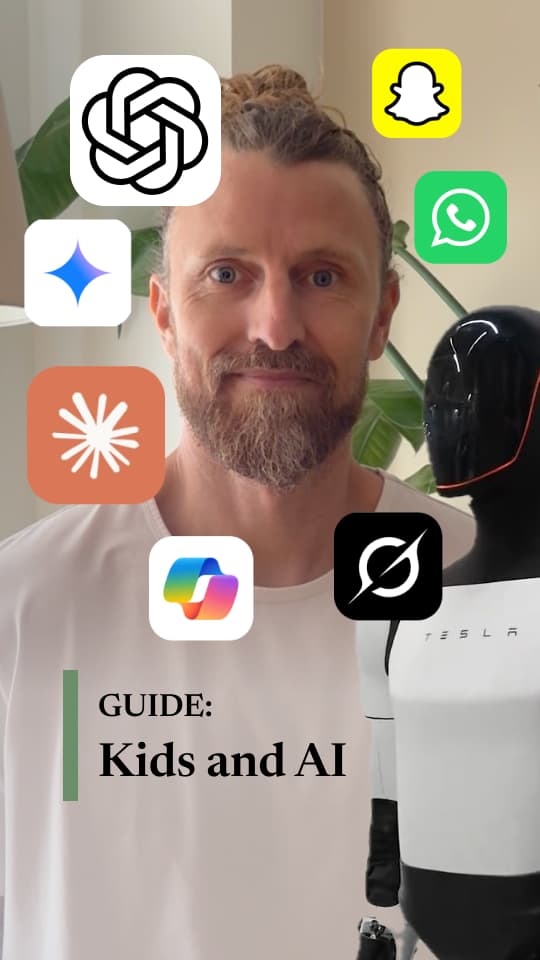
If you've never talked about AI at home, I'd start with the three open questions about AI use.
The dialogue with the kids
“You're welcome to use AI for practical things or to think out loud. I do too. But when something is painful or hard, I want you to talk to me or another adult you trust. Not because talking to AI is wrong, but because you need a real human who knows you, can see how you're doing and be there for you. AI can seem understanding, but it doesn't truly know you. I promise to do my best to understand you, whatever it's about.”
Closing thoughts
I don't think the answer is taking the chatbot away. It will be there regardless, and for much of what kids use it for, it's genuinely fine. What I want to avoid is it becoming the first stop when something hurts, because then my child misses the experience of a human being able to bear hearing it. I'm not going to beat AI on knowledge, and on availability in the middle of the night I lose every time. What I can work on is the price of coming to me.
Honesty also demands I admit I've used ChatGPT as a psychologist myself. And after getting it to mimic the tone and approach of specific well-known psychologists, I have to say it helped me work through some deep and difficult feelings well. A human psychologist would surely have been better, but in all honesty, that meant more time and money than I had. And I had no friend I wanted to drag down to that depth with me. So in my case, I still say the AI psychologist beat no psychologist.
For the kids, though, I want us parents standing between them and the psychologist, able to judge when our own knowledge and experience stop being enough to guide them.
The toolbox
Three moves that lower the threshold at home. None of them requires knowing anything about AI.
Know a parent wondering what their teenager actually uses the chatbot for? Send them this.
Sources
- EU Kids Online (12. februar 2026): European children's use and understanding of Generative AI, survey blant 25 592 barn 9–16 år i 17 land ↗
- Common Sense Media (8. juni 2026): AI Use by Tweens and Teens, første årlige undersøkelse, 1 204 barn 9–17 år ↗
- Common Sense Media (16. juli 2025): Talk, Trust, and Trade-Offs. How and Why Teens Use AI Companions, national survey, 1 060 teens 13–17 ↗
Comments
No comments yet. Be the first to say what you think.


 TikTok
 Roblox
 Snapchat
 Minecraft
 Fortnite
 YouTube
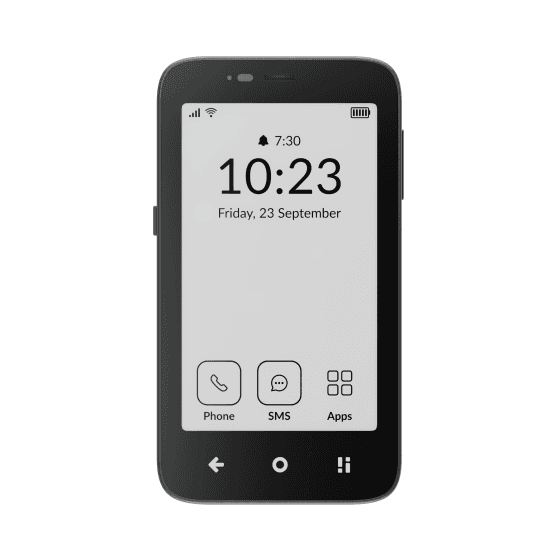 Mudita Kompakt
 Kindle Scribe
 Smiling Mind
 Opal
Opal Balance
 Homie
Homie