Hooked: the psychology that glues us to screens
Some apps are easy to put down. Others cling. The difference isn't necessarily what's on the screen but a four-step loop the tech industry has been running for over a decade. I'll take it apart step by step, with the apps your kids love as examples, so the two of you can spot it yourselves.
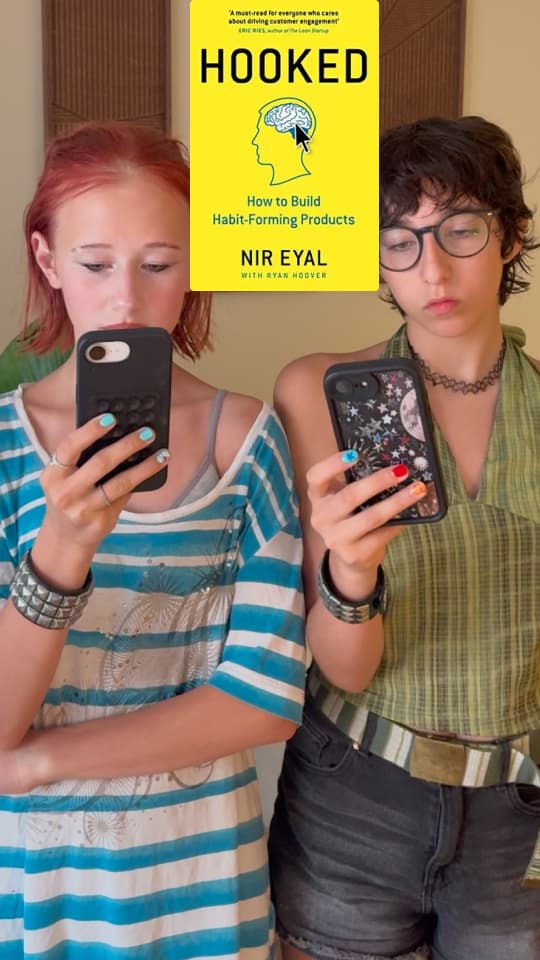
The apps that are hardest to put down all follow the same recipe: a trigger that pulls you in, one effortless action, a reward you can never predict and a small investment that raises the cost of leaving. It's a slot machine, more or less. Once you and your kids can recognise the loop, it loses much of its grip.
The recipe: four steps
It's tempting to conclude that a child who never puts down TikTok “lacks self-discipline”. That's not a fair diagnosis. The apps that stick to our hands were built to stick, by people who know their psychology. The recipe is out there for anyone to read, and it runs in four steps, over and over, until the app has become a habit:
- Trigger: whatever starts the round. A notification (an “external trigger”), or in time a feeling (an “internal trigger”).
- Action: the simplest possible next step. A swipe, a tap.
- Variable reward: something new every time, never quite predictable.
- Investment: a small effort that makes the app more yours. A streak, a follower, a playlist.
Each step does its share of the work, and the apps we get most hooked on use all four. If we're going to stand up to the world's smartest dop(amin)e dealers, we might as well learn every trick in their book.
The trigger: the nudge that starts the round
The first few rounds are set off by “external triggers”: notifications engineered to feel urgent when they aren't. But notifications are just the jump leads. The real goal is to wire the app into something that already lives in your child: boredom, loneliness, the itch of not knowing whether anyone has replied. Once that wiring is in, the app doesn't need notifications any more. Boredom shows up, and the thumb has the app open before the brain gets a vote.
Which is why “just turn off the notifications” is a good start but not the whole job. The external trigger you can remove in the settings. The internal one lives in us.

The slot machine in your pocket
Step two is the action, and it's been sanded down to almost nothing. The feed has no bottom, and the next video starts on its own. There's nowhere to stop, and that's the point: every stopping place is a chance to put the phone down. When your time is the currency being sold to advertisers, the natural stopping places get engineered away, so you stay hooked and glued to your phone.
Step three is the engine of the whole machine: a reward arrives, but you never know which one. Sometimes the next video is exactly your thing, often it isn't. Sometimes there are likes and messages waiting, sometimes nothing at all. Brain research has shown that the dopamine system fires hardest for precisely this: rewards it can't predict, and the anticipation more than the payoff. And when researchers put teenagers in a brain scanner and showed them an Instagram-style feed, the reward system lit up noticeably more when the teens' own photos had pulled in plenty of likes.
A slot machine doesn't pay out every time, and neither do apps built on the Hooked model. What keeps us hooked is the hope that the next round might be the one.
The investment: why quitting feels expensive
The final step is the sneakiest. The app gets you to leave a little of yourself inside it. Streaks that have to be kept alive. Followers, game levels, playlists, a profile that feels like “me”. All of it is value that lives in the app rather than in your child, and it sharpens the next trigger: now there's something to lose.
The Hooked model is neutral in itself
I use it myself, on this site and in the apps I build, for habits people have actually chosen. So I judge apps by who the loop is working for. Duolingo and TikTok pull many of the same levers. What separates them is the goal: a habit your child wants, or attention to be converted into ad money.
Habit or addiction? Check who's in charge
The two words get used interchangeably, but they describe different things. A habit runs on autopilot: you do it without thinking, and mostly that's your brain doing you a favour. Brushing your teeth is a habit. The Hooked loop can build good habits too; Eyal encourages exactly that.
Addiction is something else, and telling the two apart is simple. Do you carry on even when your own good sense says it's time to stop? A habit obeys you. You're in charge. You think “right, phone down”, and down it goes. An addiction doesn't obey you. You hear yourself say “that's enough now”, and the thumb keeps swiping anyway. At that point you're no longer steering the action. The loop is steering you.
If you keep going even when you rationally know it's time to stop, it has crossed from habit into addiction.
The bright and the dark side of gaming
The WHO has exactly one diagnosis in this territory that concerns kids and screens: gaming disorder. Its hallmark is that same loss of control. Gaming crowds out everything else and carries on despite obvious harm, usually for at least twelve months before anyone makes the diagnosis.
And in the interest of full honesty: gaming disorder isn't reserved for kids. I've played PlayStation all my life. It still brings me a lot of joy, and rare evenings with good friends who can only carve out the odd hour amid the everyday chaos; without the game we'd hardly meet at all. Gaming has plenty going for it: the social side, quick problem-solving, teamwork and coordination, laughter and fun. It's also a kind of mindfulness, the way sport is. It fills your head completely, which means a break from everything you're worrying about. As long as it stays a hobby and doesn't slide into addiction, gaming is a good thing.
Gaming can be a genuinely good thing. Rather than writing it off as pointless or a harmful addiction, ask your child questions and work out together how to steer it somewhere good.
For me, though, gaming has tipped over more than once, from happy hobby towards addiction. When “ok, just one more game” eats into the night and the next day belongs to a tired dad with a short fuse, I know it's time to take the wheel back. My old fix was to step off the gaming train entirely for a month or more. These past few years, knowing the mechanisms better, I've finally managed to stay in the driver's seat without falling off again. It took me a few decades. So let's put this knowledge to work and teach our kids to take control before they hit their forties.
Spotting that you're “caught in the loop” is the starting gun: now you know it's the loop that needs rebuilding, not the willpower that needs toughening up. A habit can be reprogrammed with the same four steps that built it, and an addiction can be wound back down into a habit, or into nothing.
At home, you don't need to count hours to see where your child sits on that scale. Watch how hard stopping is. If your child can wrap up when you've agreed, sighing included, your child is still the one in charge. If every single stop is a battle, even with something fun waiting, the loop has taken over, and the loop is what the two of you work on. Together, and without shame. Your child never chose to get caught in it.
Expose the loop together with your child
Now for the good news: a loop that's been exposed works less well. Not because the mechanisms stop working, but because a child who knows the trick stands a little firmer when they want to resist. It's the same reason rules hold better when kids get the reason behind them than rules that are simply enforced. Understanding travels with your child, including when you're not watching.
So rather than handing down rules, make your child a detective. Kids love catching someone in a trick, and the questions are simple:
- What made you open the app?
- What were you hoping to find?
- What have you collected in there that you'd miss?
And remember that the loop catches you too. Your child has almost certainly watched you vanish into a feed, and clocked it long before they had words for it. That's why the strongest move you have is to expose your own loops out loud: “I got stuck in my phone again. It tricked me.” A parent who admits the trick works on grown-ups does two things at once: takes the shame out of it for the child and proves it's possible to catch yourself and put the phone down.
Talking with your kids
“The apps are made by grown-ups who want you using them as much as possible, because that's how they earn money. They use tricks: surprises, so you'll want to check just one more time, and things you collect, points, streaks, followers, so that taking a break hurts. That doesn't make the apps bad, and it doesn't mean you can't use them. But when the phone is hard to put down, it's not because you're weak. It's because someone worked very hard to make it that way.”
The antidote: becoming “indistractable”
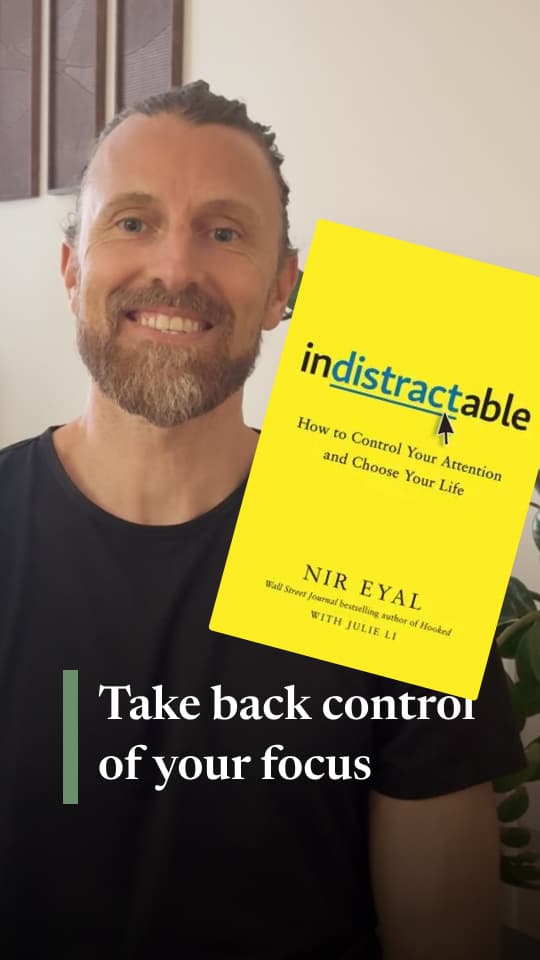
Five years after Hooked, Eyal wrote the antidote himself. Indistractable is about becoming someone who decides where their own attention goes, and the recipe has four parts: recognise the unease that makes you reach for your phone, set aside time for the things that matter to you, turn off every notification that can wait and put a little friction in front of the apps that pull hardest.
For you as a parent, the order matters: start with your own focus. Your child hears your rules, but watches what you do with your own phone many times more often.
The toolbox
Three moves that weaken the loop.
Want to make the changes right inside the apps? This tool walks you through the settings that weaken the loop in Instagram and TikTok.
Which app are we fixing?
Know parents convinced their child 'just lacks self-discipline'? Send them this.
Sources

Nir Eyal wrote the handbook on building habit-forming products: four steps that turn an app into a habit. He's careful to separate habits from addiction, and he urges readers to use the recipe for habits people actually want. The tech industry, meanwhile, works these mechanisms for all they're worth, for better and worse, on us and on our kids.
About the book ↗- Nir Eyal: Hooked-modellen (trigger, handling, belønning, investering) ↗
- Ferster & Skinner (1957): Schedules of Reinforcement ↗
- Schultz, Dayan & Montague (1997): A neural substrate of prediction and reward, Science ↗
Show more sources (2)Show fewer sources
Comments
No comments yet. Be the first to say what you think.

 TikTok
 Roblox
 Snapchat
 Minecraft
 Fortnite
 YouTube
 Mudita Kompakt
 Kindle Scribe
 Smiling Mind
 Opal
Opal Balance
 Homie
Homie